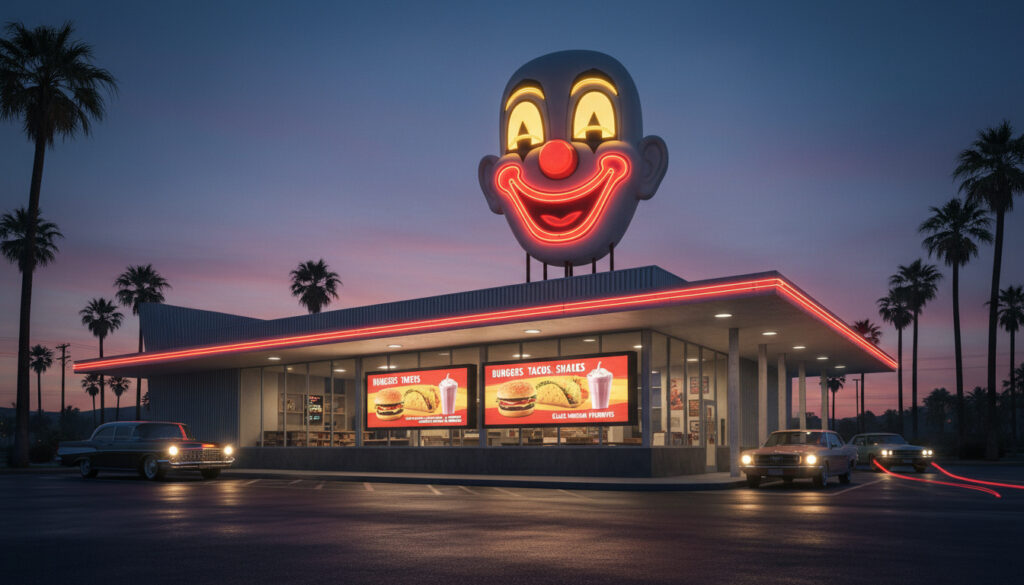
Jack in the Box – History, Menu, Locations and Facts
Jack in the Box stands as one of America’s most recognizable fast-food chains, distinguished by its clown-headed drive-thru speakers and eclectic menu that defies traditional burger-chain conventions. Founded in 1951 by Robert O. Peterson in San Diego, California, the company pioneered the two-way intercom drive-thru system, fundamentally transforming how Americans experience quick-service dining.
Headquartered in San Diego, Jack in the Box operates over 2,200 locations primarily concentrated on the West Coast, with a presence in major urban markets and two units in Guam. The chain has evolved from a single drive-thru selling 18-cent hamburgers into a publicly traded company, Jack in the Box Inc., reporting system-wide sales exceeding $4 billion as of 2025.
Despite decades of innovation, including the introduction of breakfast sandwiches and all-day breakfast service, the brand weathered significant challenges, most notably a devastating 1993 E. coli outbreak that nearly destroyed the company. Today, Jack in the Box pursues an asset-light strategy focused on franchising and digital integration while maintaining its reputation for menu diversity that extends far beyond standard burgers and fries.
What is Jack in the Box?
1951, San Diego, CA
San Diego, California
Over 2,200 (US/Guam)
Jumbo Jack, Tacos, Curly Fries
Key Insights
- Pioneered the two-way intercom drive-thru system in 1951, establishing the modern drive-thru format (source)
- Operates as Jack in the Box Inc., publicly traded on the NYSE following a 1987 management buyout and 1992 IPO (source)
- Maintains distinct West Coast concentration with limited East Coast presence following historical expansion challenges
- Survived near-bankruptcy after the 1993 E. coli outbreak that infected 732 people and caused four deaths
- Transitioned to asset-light franchise model in recent years, selling company-owned locations to operators
- Previously owned Qdoba Mexican Grill (2003-2017) and Del Taco (2021-2025) before divesting both
- Offers all-day breakfast menu, a rarity among legacy fast-food chains during the 1980s and 1990s
Company Facts
| Fact | Details |
|---|---|
| Founder | Robert O. Peterson |
| First Location | San Diego, California (1951) |
| Original Price Point | 18 cents for hamburgers |
| System-wide Sales (2025) | Exceeds $4 billion |
| Peak Locations (2022) | Approximately 2,800 (including Del Taco) |
| Current Ownership | Public (Jack in the Box Inc.) |
| 1987 Sales | $655 million (pre-IPO) |
| 1993 Outbreak Impact | 732 infections, 171 hospitalizations |
| Qdoba Sale (2017-2018) | $305 million to Apollo Global Management |
| Del Taco Sale (2025) | $115 million to Yadav Enterprises |
Jack in the Box Menu Highlights and Prices
What is on the Jack in the Box menu?
Robert O. Peterson launched the original location with a simple offering: hamburgers priced at 18 cents and tacos. This unconventional combination—burgers alongside Mexican-inspired items—established a menu philosophy that persists today. By 1987, the chain expanded to approximately 40 distinct items, including ham and cheese sandwiches, fajita pitas, to-go salads, and finger foods (source).
The company claims distinction as the first major fast-food chain to introduce finger foods in 1982, predating competitors’ similar offerings. Current menu categories span burgers, chicken, tacos, breakfast items, sides, and desserts, with the Jumbo Jack burger and curly fries serving as signature products. The chain also offers the Moby Jack fish sandwich, reflecting its historical willingness to diversify beyond beef.
Jack in the Box menu prices
Pricing varies by market, though the company maintains value positioning comparable to mid-tier fast-food competitors. Specific dollar amounts fluctuate based on regional operating costs and franchisee discretion.
Does Jack in the Box have breakfast all day?
Breakfast items remain available throughout operating hours, a policy the chain pioneered when most competitors restricted morning menus to specific times. This includes breakfast sandwiches, hash browns, and coffee beverages available during lunch and dinner periods.
The 1985 temporary rebranding to “Monterey Jack’s” attempted to emphasize premium positioning but lasted only one year before reverting to the original name due to customer backlash.
Jack in the Box Locations and Hours
Where are Jack in the Box locations?
Geographic concentration defines Jack in the Box’s footprint. While the chain operates over 2,200 locations, these cluster heavily along the Western United States, with significant density in California, Texas, Arizona, and the Pacific Northwest. The company maintains two locations in Guam, representing its only international presence beyond the continental United States.
Major urban areas host the majority of units, aligning with the company’s strategy of targeting mature, high-traffic markets. This West Coast dominance stems from historical expansion patterns; after Ralston Purina acquired the chain in 1968, rapid growth brought locations to 870 by decade’s end, though East Coast attempts later faltered.
What are Jack in the Box hours?
Hours vary by location, though most restaurants operate from early morning through midnight or later. Drive-thru service remains available at nearly all locations, reflecting the chain’s origins as a drive-thru-only concept. For specific restaurant hours and operations, individual store locators provide exact times.
Jack in the Box Delivery and Nutrition Info
Does Jack in the Box deliver?
Digital integration supports modern delivery options, with the company emphasizing app-based ordering and third-party delivery partnerships. The asset-light strategy focuses heavily on digital growth, streamlining delivery logistics through technology rather than maintaining proprietary delivery fleets.
Jack in the Box nutrition facts
Nutritional information varies by menu item. While the chain previously offered detailed nutritional guides, current specifications require direct consultation with official sources. Customers seeking precise dietary data should reference official company resources or inquire at specific locations.
An E. coli outbreak from undercooked beef patties infected 732 customers across multiple states, hospitalizing 171 and killing four children. The incident prompted industry-wide adoption of HACCP protocols and nearly caused bankruptcy.
Following the December 2025 sale of Del Taco, Jack in the Box Inc. focuses exclusively on its flagship brand, pursuing franchising growth in major metropolitan markets while divesting company-owned locations.
How Has Jack in the Box Changed Over Time?
- 1941: Robert O. Peterson establishes Topsy’s Drive-In, later renamed Oscar’s, introducing early drive-thru concepts (source).
- 1951: First Jack in the Box opens in San Diego featuring the two-way intercom drive-thru and iconic clown speaker.
- 1968: Ralston Purina acquires the chain, enabling nationwide expansion that reaches 870 units by 1970.
- 1980: Company pivots to adult-oriented marketing, retiring the original clown mascot.
- 1987: Management buyout occurs; sales reach $655 million with 897 restaurants preceding the 1992 IPO (source).
- 1993: Deadly E. coli outbreak affects 732 people, forcing implementation of HACCP safety protocols (source).
- 2003: Acquisition of Qdoba Mexican Grill diversifies the corporate portfolio.
- 2022: Del Taco acquisition adds approximately 600 locations for $12.51 per share.
- 2025: Del Taco sold to Yadav Enterprises for $115 million, finalizing December 22 (source).
What Facts Are Verified About Jack in the Box?
| Established Information | Information Remaining Unclear |
|---|---|
| Founded February 21, 1951, in San Diego by Robert O. Peterson | Current CEO identity not disclosed in available corporate filings |
| Over 2,200 operational locations as of 2025 | Exact employee count across franchise and corporate locations |
| System-wide sales exceed $4 billion (2025) | Specific holiday operating schedules vary by franchisee |
| 1993 E. coli outbreak infected 732, killed 4 | Current detailed nutrition facts for all menu items |
| Del Taco sold December 22, 2025, for $115 million | Future expansion targets beyond “major metropolitan areas” |
What Role Does Jack in the Box Play in the Fast Food Industry?
Jack in the Box occupies a unique market position, targeting mature Western U.S. consumers rather than engaging directly in national burger wars dominated by larger competitors. The chain differentiates through menu diversity that includes tacos, egg rolls, and specialty sandwiches alongside traditional burgers, appealing to customers seeking variety beyond standard fast-food fare.
The company’s jobs and employment stats reflect significant operational scale, though specific workforce numbers remain dispersed across franchise operations. Unlike competitors focused on breakfast dayparts, Jack in the Box maintains all-day breakfast availability, a strategy that predates industry-wide adoption of similar policies by decades.
Recent strategic shifts emphasize digital integration and franchising over corporate ownership, positioning the brand as an asset-light operator focused on brand management rather than real estate holdings. This model mirrors broader industry trends toward capital-efficient growth, though the chain maintains its distinct West Coast identity and menu innovation heritage.
What Do Official Records Reveal About Corporate Strategy?
Jack in the Box Inc. operates with an asset-light strategy focused on digital growth, franchising, and major metropolitan markets.
— Corporate Investor Relations, Jack in the Box Inc.
The company pioneered the two-way intercom drive-thru in 1951, fundamentally establishing the operational model for modern fast-food service.
— Historical Analysis, Matrix BCG
What Defines Jack in the Box Today?
Jack in the Box operates as a West Coast-centric fast-food chain with over 2,200 locations, distinguished by all-day breakfast offerings, menu diversity including tacos and egg rolls, and a legacy of drive-thru innovation dating to 1951. The publicly traded company, headquartered in San Diego, emerged from near-bankruptcy following the 1993 E. coli crisis to pursue an asset-light franchising model, divesting recent acquisitions Qdoba and Del Taco to focus on core brand growth and digital integration in major metropolitan markets.
Frequently Asked Questions
Is Jack in the Box open on holidays?
Operating hours vary by location and franchisee discretion. Most locations remain open on major holidays, though specific schedules require confirmation through individual store locators or the company’s website.
How many Jack in the Box locations are there?
The company operates over 2,200 restaurants primarily across the Western United States and Guam as of 2025, following the divestiture of Del Taco locations.
Does Jack in the Box have breakfast all day?
Yes. The chain offers breakfast menu items throughout operating hours, a policy it pioneered when most competitors restricted morning items to specific time windows.
Who founded Jack in the Box?
Robert O. Peterson founded the chain on February 21, 1951, in San Diego, California, building upon his earlier drive-in operations dating to 1941.
What is Jack in the Box known for?
The chain is recognized for pioneering the two-way intercom drive-thru, its clown-headed speaker design, diverse menu including tacos and egg rolls, and all-day breakfast availability.
More related posts
 Province of Canada Clothing: Reviews, Stores & Made in Canada
 Bullying in Canada Schools: Stats, Reporting & Help
 The Diplomat Season 3: Release Date, Episodes, Cast & Ending
 Justin Rose Golfer: Age, Wife, Children, Net Worth, and More
 Mercedes-Benz Steering Recall Canada: Models & Fixes 2024
 Cast of The Family Stone: Actors, Roles & Where Are They Now
 How to Make Kimchi: A Beginner’s Guide
 Winnipeg Houses for Sale: Prices, Listings & Neighborhoods 2025